Fun Waiting Activities for Kids: Autism Social Skills Games for Preschool & Kindergarten


Meta Description: Discover fun waiting activities for preschool, kindergarten, and autistic children. Learn research-backed strategies, games, pretend play ideas, and classroom activities that teach waiting through play.
Waiting is one of the very first social skills children begin learning, but it is also one of the most challenging.
Whether children are waiting for a favorite toy, standing in line for the playground, waiting for a snack, or waiting for their turn during a game, those few moments can feel incredibly long. For many autistic children and other young learners, waiting requires much more than simply standing still. It involves self-control, flexible thinking, communication, emotional regulation, and the ability to understand that something desirable will happen—but not quite yet.
The good news is that waiting is a skill that can be taught.
Just like learning to greet a friend, share toys, or take turns, children become more successful when they have many opportunities to practice in fun, supportive, and meaningful ways.
One of the biggest misconceptions about teaching waiting is that children simply need more reminders to "be patient." In reality, most children benefit from being explicitly taught how to wait. They need strategies they can use while waiting, opportunities to practice when they are calm, and repeated successful experiences that help build confidence over time.
⭐ In This Article You'll Learn
Why waiting is an important developmental skill
Why waiting can be especially challenging for many autistic children
What waiting really teaches beyond simply "being patient"
Seven hands-on waiting activities that make learning fun
Simple strategies for teaching waiting successfully
Common mistakes to avoid
Answers to frequently asked questions about teaching waiting
TL;DR
Teaching children to wait is much easier when waiting has a purpose.
Instead of asking children to simply "be patient," create opportunities where waiting naturally becomes part of an enjoyable activity. Games, movement, music, pretend play, and visual supports all help children practice waiting in meaningful ways while gradually building confidence, self-regulation, and independence.

Table of Contents
Why Waiting Is an Important Social Skill
Waiting is woven into almost every part of a child's day.
Children wait to wash their hands.
They wait in line for recess.
They wait for a turn with a favorite toy.
They wait while a classmate answers a question.
Although these moments may seem small, they provide valuable opportunities for children to develop self-control, communication, flexibility, and emotional regulation.
Many adults assume children naturally learn to wait simply by getting older. While maturity certainly plays a role, research tells us that executive functioning skills—such as impulse control, self-regulation, and cognitive flexibility—develop best through repeated practice in supportive environments.
Like any other developmental skill, waiting improves when adults intentionally teach it, model it, and create opportunities for children to experience success.
Why Waiting Can Be Especially Difficult for Autistic Children
Many autistic children genuinely want to wait successfully.
The challenge is that waiting often requires several different skills to work together at the same time.
Children may need to:
stop themselves from immediately grabbing a preferred item
tolerate uncertainty about when something will happen
understand that a preferred activity is coming later
regulate feelings of excitement or disappointment
communicate appropriately while waiting
shift attention away from something highly motivating
remain engaged without becoming frustrated
For some children, the idea of time itself can be difficult to understand. Others may become anxious if they don't know exactly what will happen next or how long they will be expected to wait.

These challenges don't mean a child is being stubborn or intentionally refusing to wait.
They simply remind us that waiting is a developmental skill—one that often benefits from explicit instruction, visual supports, predictable routines, and repeated successful practice.
One of my favorite approaches is to teach children that waiting doesn't have to mean doing nothing.
Instead, waiting becomes an active skill.
Children learn to count, sing, take deep breaths, watch a timer, play a waiting game, or engage in conversation while they wait.
Those simple strategies often transform waiting from a frustrating experience into one children feel capable of managing.
What Waiting Really Teaches
When we think about teaching waiting, it's easy to focus only on helping children stand quietly in line or wait for a turn.
In reality, waiting is much bigger than that.
Every successful waiting experience strengthens skills children will continue using throughout their lives.
Executive Functioning
Executive functioning refers to the mental skills that help us control impulses, focus attention, plan ahead, remember information, and complete tasks.
Every time children pause before grabbing a toy, wait for the rocket launch countdown, or stop themselves from interrupting a friend, they are strengthening inhibitory control—one of the most important executive functioning skills during early childhood.
Research has shown that executive functioning skills continue developing throughout childhood and can be strengthened through intentional teaching and repeated practice (Diamond, 2013; Diamond & Lee, 2011).
Emotional Regulation
Waiting often brings big emotions.
Children may feel excited.
They may feel disappointed.
They may feel frustrated.
Learning simple waiting strategies—such as taking deep breaths, counting, singing, or using visual supports—gives children practical tools they can use to manage those emotions successfully.
Rather than simply telling children to "calm down," we teach them how to stay calm while they wait.
Flexible Thinking
Waiting also teaches children that life doesn't always happen immediately.
Sometimes another child gets the first turn.
Sometimes we have to wait in line.
Sometimes our favorite activity isn't available yet.
Learning to tolerate those small delays helps children become more flexible thinkers, an important skill that supports problem solving and coping with everyday changes.
Communication
Waiting creates wonderful opportunities for children to practice communication.
Instead of seeing waiting as "doing nothing," we can encourage children to use those moments to interact with the people around them.
While waiting, children might learn to:
ask, "Can I have a turn next?"
request help appropriately
comment about what they notice
answer simple questions
talk with a peer
ask how much longer they need to wait
These everyday conversations strengthen language skills while helping children stay engaged during naturally occurring wait times.
Delayed Gratification
Perhaps most importantly, waiting teaches children that good things often happen after waiting.
The bubbles get popped.
The rocket launches.
The pretend food arrives at the restaurant.
Their favorite toy comes back.
When children repeatedly experience these successful endings, they begin building confidence that they can wait—and that waiting is simply part of everyday life.
What Does the Research Say?
Research consistently shows that executive functioning and self-regulation are closely connected to children's later academic success, independence, and social relationships.
Studies have found that children strengthen these skills through supportive environments, intentional teaching, and repeated opportunities to practice—not simply by being expected to "figure it out" on their own (Diamond & Lee, 2011).
For autistic children, structured routines, visual supports, predictable expectations, and explicit instruction have all been shown to improve participation during everyday activities. These supports reduce uncertainty while helping children understand exactly what is expected, making waiting feel much more manageable.
The great thing is that these strategies don't require expensive materials or complicated lessons. Some of the most meaningful learning happens during ordinary routines and simple play experiences like the activities below.
7 Fun Waiting Activities for Kids
One of my favorite things about teaching waiting is that it doesn't have to feel like a lesson.
When children are laughing, building, pretending, singing, or moving, they often don't realize they're practicing an important life skill.
The activities below are designed to make waiting feel purposeful, engaging, and successful.
1. Wait Mat Activity
One of the easiest techniques for teaching waiting is the Wait Mat.
This technique like all things, will go better if it is practiced in a structured setting initially. Take a simple motor task that you know the child can easily complete such as putting a block in a cup or a coin in a Connect Four style game and have the child complete one motor action before getting their toy or object back.
Instead of removing a child's favorite toy, the preferred item stays nearby on a "waiting mat" where the child can still see it while completing one very short activity. This simple change helps reduce anxiety while teaching children that waiting has a predictable ending.
For example, a child might place a favorite toy on the waiting mat while putting one coin into a bank, dropping one block into a container, or completing one simple matching task. As soon as the task is finished, the child immediately gets the preferred item back.
Over time, you can gradually increase the number of actions before returning the item. The goal is never to frustrate children. The goal is repeated success.

Why It Works
Keeping the preferred item visible helps build trust and reduces anxiety while children practice short, successful periods of waiting.
Skills Practiced
• Waiting
• Self-regulation
• Impulse control
• Following directions
Great For
✔ Autism
✔ Preschool
✔ Kindergarten
✔ Early Intervention
Teacher Tip
Start with a wait the child can successfully complete—even if it is just one second. I've worked with many young children who first needed to learn that they could successfully wait for a single second before gradually increasing their waiting time. Those tiny successes build confidence and create the foundation for longer waits later.
2. Pop the Bubble
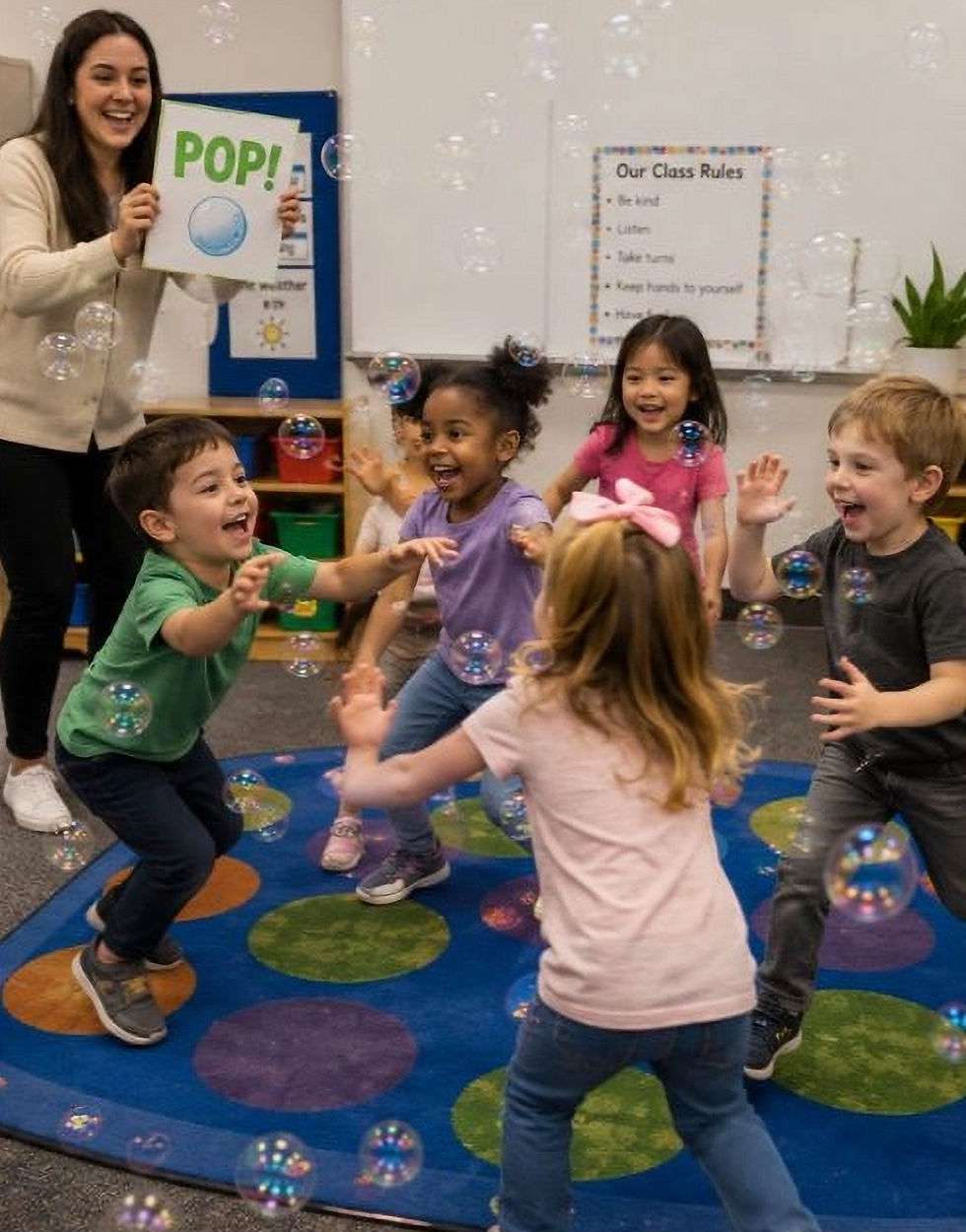
You will rarely meet a young child that does not enjoy bubbles and that's what makes this activity a winner for teaching waiting skills.
This simple game turns bubble play into an opportunity to practice impulse control and waiting.
Blow bubbles into the air and encourage children to watch them float. Everyone freezes while counting together:
One...Two...Three...GO!
When children hear "Go," they can run and pop as many bubbles as possible.
Because children know they'll soon have an opportunity to pop the bubbles, they're often much more willing to wait.
As children become more successful, you can slowly increase the waiting time or encourage them to use one of the waiting strategies they've already learned, such as counting, singing, or taking deep breaths.

Why It Works
Children stay motivated because they know something exciting is about to happen. The anticipation itself becomes part of the lesson.
Skills Practiced
• Waiting
• Listening
• Self-control
• Following directions
• Gross motor skills
Great For
✔ Outdoor play
✔ Movement breaks
✔ Whole group
✔ Small groups
Teacher Tip
It's much better to have ten successful waiting opportunities than one frustrating one. Keep wait times short enough that children are successful.
3. Restaurant Pretend Play

Dramatic play is one of my favorite ways to teach social skills because children are practicing real-life situations without realizing they're learning.
A simple restaurant center naturally creates dozens of opportunities to practice waiting.
Children may:
wait to be seated
wait for a menu
wait to order
wait for pretend food
wait while another customer is served
wait for the check

Unlike structured drills, these waiting moments have a purpose.
Children are motivated to wait because they're engaged in meaningful play.
Even better, one activity naturally supports several other important social skills, including greetings, conversation, requesting, taking turns, and polite manners.
It is important to note that as with all activities if a child does not tend to enjoy pretend play, then this is not an ideal time to work on another skill they find challenging such as waiting.
Why It Works
Pretend play creates natural reasons to wait. Because the waiting is part of the game, many children are more willing to practice than during structured teaching activities.
Skills Practiced
• Waiting
• Greeting
• Conversation
• Requesting
• Taking turns
• Pretend play
Great For
✔ Dramatic play centers
✔ Small groups
✔ Inclusive classrooms
Teacher Tip
Whenever possible, use real menus, aprons, trays, empty food containers, or simple props. Children are often much more motivated when dramatic play feels authentic.
4. The Wait Song

Music is another actvitiy that is often popular with autistic or neurodivergent learners.
In this activity, children learn a simple "wait song" and then practice it while waiting for a motor activity, such as waiting for the swing or the slide.
If possible, make the words simple enough for emerging language users and put to a melody that is easy to remember such as "Row Row Your Boat."
Initially you can provide a visual support to help remind children that they can sing while waiting their turn but don't be surprised if you eventually hear them singing on their own as they wait for activities.
After introducing the song during circle time, continue using it throughout the day whenever children naturally need to wait.
Why It Works
Music helps children remember. Repetition makes waiting strategies easier to recall during everyday situations.
Skills Practiced
• Self-regulation
• Waiting
• Coping strategies
• Group participation
Great For
✔ Circle time
✔ Transitions
✔ Waiting in line
✔ Small groups
Teacher Tip
Laminate the song visuals and keep them on a binder ring so they're easy to grab whenever waiting naturally occurs throughout the day.
5. Rocket Launch Countdown

Few activities create as much excitement as launching a rocket.
Whether you're using a stomp rocket or children are pretending to be the rocket, children quickly become invested in the countdown.
The challenge?
Nobody launches until everyone waits together.
Count backwards as a group:
10...9...8...7...6...
The anticipation builds with every number.
Children are practicing one of the hardest parts of waiting—stopping themselves from acting immediately—even though they're completely engaged in the activity.
When the rocket finally launches, children experience an important lesson:
Waiting made the exciting part even more fun.
This activity quickly becomes a classroom favorite because children almost always ask to do it again, giving you repeated opportunities to practice waiting in a fun and motivating way.
I usually begin with a 3, 2, 1 countdown and gradually increase the numbers. If you have children that are highly motivated by letters and numbers you can pair this with number visuals.
Why It Works
The excitement of the countdown gives children a meaningful reason to wait. Instead of focusing on the delay, they focus on the exciting event that comes next.
Skills Practiced
• Waiting
• Self-control
• Listening
• Delayed gratification
• Following directions
Perfect For
✔ Whole group
✔ Small groups
✔ Outdoor learning
✔ STEM activities
Teacher Tip
Try changing the length of the countdown occasionally. Sometimes count down from five and other times from ten so children learn to listen rather than simply memorizing the routine.
6. Listen & Echo

This simple listening game encourages children to pause before responding. Hand out rhythm sticks, shaker eggs, or just clap hands.
Play a simple rhythm.
Children listen carefully...
Wait...
Then when given a signal repeat the pattern.
As children become more successful, you can make the rhythm more complicated or longer.
Why It Works
Children learn that successful waiting helps them become better listeners. Instead of rushing to respond, they pause, process the information, and then participate.
Skills Practiced
• Waiting
• Listening
• Attention
• Auditory memory
• Self-control
Perfect For
✔ Circle time
✔ Speech therapy
✔ Small groups
✔ Classroom transitions
Teacher Tip
Keep early patterns very short so children experience success quickly. As their listening skills improve, gradually increase the length and complexity of what they repeat.
7. Build the Block Tower

Building together naturally encourages children to wait. You can demonstrate the benefits of waiting initially by having everyone come up and add a block at the same time and discuss if the tower got very tall and if the blocks stayed stacked up.
Then invite children to come up one at a time so they have to wait between and see if their block tower is able to get taller.
As excitement builds, children become highly motivated to wait because they want to see how tall the tower can become before it falls.
If the tower topples over?
Even better.
Most children immediately want to build another one, creating another opportunity to practice waiting while working together toward a shared goal.
Why It Works
Children are focused on a shared goal rather than on waiting itself. Cooperative activities naturally encourage patience, teamwork, and positive peer interactions.
Skills Practiced
• Waiting
• Taking turns
• Cooperation
• Teamwork
• Fine motor skills
Perfect For
✔ Centers
✔ Small groups
✔ Inclusive classrooms
✔ Cooperative learning
Teacher Tip
For an extra challenge, roll a die before each turn and add that many blocks. This adds another layer of anticipation while incorporating early math skills.
Everyday Opportunities to Practice Waiting
One of the best ways to practice waiting occurs during everyday routines. Encourage children to practice their waiting strategies during activities throughout the day such as:
washing their hands
lining up for recess
waiting for snack or lunch
waiting for teacher help
waiting to choose a center
waiting for a favorite toy
waiting to use classroom materials
waiting for a turn on the playground
waiting during transitions
waiting while a friend finishes speaking
These moments may only last a few seconds, but they happen dozens of times throughout the day.
When adults consistently coach children through these everyday situations using the same language and strategies, waiting gradually becomes part of the child's daily routine rather than something that only happens during a lesson.
Tips for Teaching Waiting Successfully
Start Small
Successful waiting doesn't begin with minutes.
It begins with success, which often means mere seconds.
For some children, that may mean waiting just one second before receiving a preferred item.
As children become more confident, gradually increase expectations one small step at a time.
Make Waiting Predictable
Whenever possible, let children know:
what they're waiting for
how long they'll wait
what will happen next
Visual timers, picture schedules, countdowns, and First/Then language all help make waiting feel more manageable.
Give Children Something To Do
Waiting becomes much easier when children have an active strategy.
Teach children to:
count
sing
take deep breaths
watch a timer
look at a book
Instead of simply saying, "Wait," you're teaching children how to wait successfully.
Celebrate Success
Notice successful waiting throughout the day.
Instead of saying,
"Good job!"
try describing exactly what you observed.
"You waited while your friend finished building. That was very patient."
Specific praise helps children understand exactly which behaviors you want to see again.
Practice When Children Are Calm
One of the best times to teach waiting is before children become frustrated.
Games, songs, pretend play, and classroom routines provide low-pressure opportunities to practice that naturally carry over into more difficult situations.
Common Mistakes to Avoid
❌ Expecting children to wait too long too soon.
❌ Only practicing waiting during frustrating situations.
❌ Taking preferred items away without warning.
❌ Forgetting to teach waiting strategies.
❌ Treating waiting like a punishment instead of a skill.
Frequently Asked Questions
At what age should children learn to wait?
Many children begin developing waiting skills during the toddler years, although this can vary greatly for different children. For many toddlers, waiting begins with only a few seconds before receiving a favorite toy or snack. Rather than focusing on a specific age or length of time, build on each child's individual success.
Why is waiting especially difficult for some autistic children?
Waiting often requires executive functioning, emotional regulation, communication, and flexible thinking—all skills that may be more challenging for some autistic children. Visual supports, predictable routines, and direct teaching can make waiting much more manageable.
How long should children practice waiting?
There isn't one "correct" amount of time.
Start with a wait the child can successfully complete—even if it is just one second.
I've worked with many young children who first needed to learn that they could successfully wait for one second before gradually increasing their waiting time. Those tiny successes build confidence and lay the foundation for longer periods of waiting.
Should I use rewards for waiting?
Positive reinforcement can be very helpful, especially when children are first learning a new skill, but in the best-case scenario, the activity itself provides the reward, i.e. wait and then get a turn on the slide. Over time, the goal is to help children experience waiting as a normal part of everyday life while gradually reducing adult support.
Continue Learning
If you enjoyed these waiting activities, you might also enjoy these related posts:

Although this free social story focuses on taking turns, it naturally reinforces many of the same waiting skills discussed in this article and is a wonderful companion resource for young learners.
Featured Resource
If you're looking for even more hands-on ways to teach waiting, my Waiting Activities & Games resource expands on the ideas in this article with structured lesson plans, realistic photo visuals, movement games, pretend play, songs, cooking activities, classroom posters, worksheets, and printable teaching materials designed specifically for preschool, kindergarten, special education, and autistic learners.

About the Author
Tracy Hilgenfeld is a special education teacher, autism consultant, and founder of Rainbow Autism Resources. She has spent more than 30 years developing practical, play-based resources for autistic children, educators, therapists, and families.
➡️ Learn more about Tracy and Rainbow Autism Resources.
Final Thoughts
Waiting is a skill that touches almost every part of a child's day.
Whether children are waiting for a turn, waiting in line, or waiting for something exciting to happen, these everyday moments provide valuable opportunities to build patience, communication, self-regulation, and confidence.
The wonderful thing about teaching waiting is that it doesn't require complicated materials or lengthy lessons. Some of the best learning opportunities happens while playing with bubbles or blocks.
When children experience repeated success, they begin to discover something incredibly important:
They can wait.
And once children believe they can do something, they're much more likely to be successful the next time.
Do you have a favorite waiting activity? I'd love to hear about it below.
References
Center on the Developing Child at Harvard University. (2011). Building the Brain's "Air Traffic Control" System: How Early Experiences Shape the Development of Executive Function.
Diamond, A. (2013). Executive functions. Annual Review of Psychology, 64, 135–168.
Diamond, A., & Lee, K. (2011). Interventions shown to aid executive function development in children 4 to 12 years old. Science, 333(6045), 959–964.


Comments