Think It or Say It? 5 Social Filter Games and Activities for Kids


A child notices a classmate’s haircut and says exactly what they think. The child may be telling the truth, but the classmate still feels hurt.
This can be a familiar challenge for autistic people, from young children through adulthood. Honesty is a strength, and we don’t need to teach children to hide every opinion or agree with everyone. We can help them recognize that words affect other people—and that there is often a kinder way to communicate the same thought.
For young children, “use your social filter” can be too abstract to help in the moment. I like using a traffic light to make the decision more concrete:
Red: Stop before the thought comes out.
Yellow: Think about the words and how the other person might feel.
Green: Decide what to say. Sometimes the original thought is fine. Sometimes it needs kinder wording, and sometimes it can stay private.

The goal is to practice this when everyone is calm, through stories and games, instead of trying to teach the whole skill after someone’s feelings have already been hurt.
In this post
What does “think it or say it” mean?

“Think it or say it” gives children a way to consider whether a thought needs to be spoken aloud. Some thoughts are helpful to share. Some could hurt or embarrass someone. Others express a real need but would work better with different words.
This skill is about more than sorting statements into two piles. A child who says, “This food is disgusting,” might be trying to tell us they dislike sauce. Once we understand their meaning, we can help them communicate it clearly: “I don’t really like things with sauce on them.”
What does research tell us about teaching social communication?

Researchers often call the social use of language pragmatic language. A review of studies on pragmatic language interventions for autistic children found some promising approaches, while also emphasizing that children need chances to actively participate and practice with other people.
I like to pair pictures and stories with discussion, games, and examples from daily life.
Pictures and traffic lights make the idea easier to discuss. The learning happens as children consider what they mean, how their words might land, and what else they could say.
Start with a picture and a conversation

Show a picture of an everyday situation and offer a possible comment: “Your painting is bad.” Ask, “How might the painter feel if they heard that?”
Then explore the thought behind the words. Maybe the child means, “I would have used different colors.” They’re allowed to think that. Do they need to tell the painter? If they want to talk about the painting, could they say something else that is both true and considerate?
Keep the conversation curious. Some situations will have more than one reasonable answer, and that discussion is often more useful than getting the “right” color light.
You can do this with pictures from books, drawings you make together, or examples from pretend play. My Say or Think social filter bundle includes a social narrative with photographs and a sequence activity if you would like the visuals prepared for you.
If you’d like more ideas for using short stories to introduce a skill and then discuss it with a child, see my guide to autism social skill stories.
Try an interactive “say it or think it” book
An adapted book gives children repeated chances to make a choice. Look at one scene at a time, read the possible thought aloud, and let the child select a red light for “keep that thought private” or a green light for “okay to say.”
After they choose, ask one short follow-up question: “Why?” or “What else could you say?” A child who isn’t ready to explain can point to the light, a face showing a feeling, or a choice you offer aloud.

To make a simple version yourself, draw two circles on paper—one red and one green—and use pictures or situations you already have. The interactive book in my bundle has picture scenarios and spaces for children to place the traffic light choices.
If your child or student communicates by pointing to pictures, my post on using picture cards to support nonverbal and minimally verbal children has more ways to make visual choices part of a conversation.
Play Red Light, Green Light with thoughts

Once children understand that a red light thought may be better kept private and a green light thought is okay to say aloud, they can practice making that decision while they move. These two games use the same idea in different ways.
Game 1: Say It or Stay Put
Think of a mix between "Mother May I" and a traditional "Red Light Green Light Game". Mark a starting line and have children stand side by side, several steps away from you. Read a different statement to each child on their turn and ask, “Is that a red light or green light thought?”

For a green light thought, the child takes one step forward. For a red light thought, they stay where they are. Continue taking turns until someone reaches you. Staying put can be the correct move—a point worth celebrating, especially when everyone else seems eager to take a step.
Start with clear examples, such as “I like your new backpack” and “Your house is messy.” Read the statements aloud so children don’t need to read the cards, and let them point to a red or green visual if they would rather answer that way. If a child is unsure, ask, “How might someone feel hearing that?” Keep the steps small, give everyone a turn before the next round, and play again so more children have a chance to reach the finish.
Game 2: Move to the Red or Green Light
Another fun game involving the idea of traffic lights is Move to the Light game. Place a red traffic light on one side of the room and a green traffic light on the other. Have children start in the center. Read one statement aloud, give them a moment to think, then say, “Choose your light!” Everyone moves toward the light that matches their choice.

Ask a child at each light to explain their thinking. How might someone feel hearing those words? Could the statement sound different depending on the situation or tone of voice? Children can change lights after the discussion if they reconsider their answer. Then everyone returns to the center for the next statement.
Walking works well in a classroom; children can run when there’s enough open space to do so safely. A child who cannot easily move across the room can point to a light instead.
You can make either game with red and green paper circles and statements you write yourself. If you would like the cards and traffic light visuals prepared for you, they’re part of my Say or Think social filter activities.
Use photo cards for a second traffic light game
Some children find it easier to think about words when they can see the situation. Show a photo scenario, read the proposed comment, and let the child hold up a red or green light. Rather than simply moving to the next card, ask what the person in the picture might think or feel.
The Red Light Green Light Thoughts game uses realistic photo scenarios and traffic light visuals for this practice. You can use the same idea with familiar picture books or photographs you have permission to use.
Turn the practice into a board game
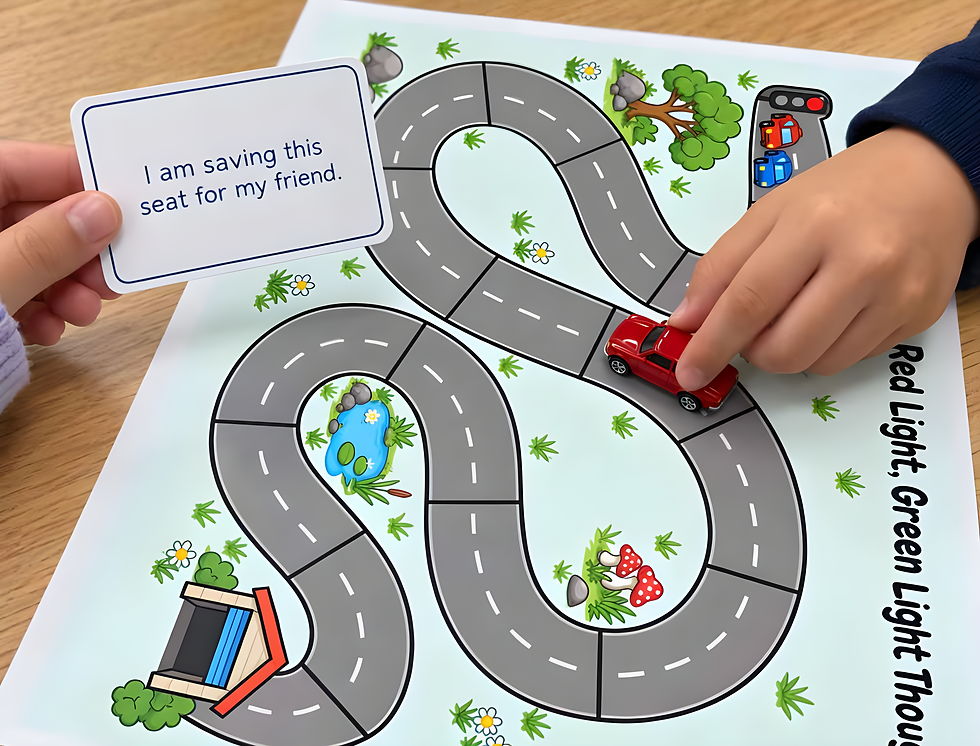
If a child enjoys board games, place a small stack of “say or think?” situations beside any simple game board. On each turn, the player moves their piece and considers one situation. They can choose to say the comment, keep it private, or try a kinder version.
Encourage children to explain their thinking, change their minds, and notice that context matters. A game board you already own, a die, and a few handwritten scenarios work well for this.
What could they say instead?
Sorting comments into “say” and “think” is a starting point. Sometimes the child has something they genuinely need to communicate. Once they’ve stopped to think, help them figure out what they meant and find words that say it.
If a child says… | They might mean—or could say… |
“I hate your new haircut.” | “Your new haircut surprised me.” They may simply be noticing a change and need time to get used to it. |
“This food is disgusting.” | “I don’t really like things with sauce on them.” This tells the adult something useful about the child’s preference. |
“I don’t want to sit by him.” | “I was really hoping to sit by Maya today,” or “I want to sit by myself today.” The child can ask for what they want without making the other child feel rejected. |
“His glasses are ugly.” | They might be noticing something unfamiliar. They could keep the opinion private or, if they want to talk about glasses, say, “I don’t wear glasses.” |
“Your painting is bad.” | “I would have used different colors.” Or they could simply let their classmate enjoy the painting without commenting on it. |
“You talk too much.” | “I need some quiet right now,” or “Can I have a turn to talk?” |
These aren’t scripts children must use word for word. They’re examples to discuss together. Ask: “What were you trying to tell them?” and “How else could you say it?” Sometimes the best answer is a kinder sentence. Sometimes there is no need to comment at all.
And children are allowed to say no, express discomfort, ask questions, and speak up when something is wrong. The skill is choosing words that communicate their meaning while considering the listener.

You can practice every activity here with materials you already have. If you would like the stories, pictures, and traffic light visuals prepared for you, you can see the Say or Think social filter bundle or start with the standalone photo card game.


Comments