Gestalt Language Processor: Recognizing and Supporting Echolalia


I have a very fond memory from my time volunteering at a camp for children with special needs in England when I was in my early twenties. There was a little boy who, every time he saw me, would excitedly exclaim in a perfect Midwestern American accent, “Hi! My name is Tracy!”—despite being British himself. I was truly impressed by how accurately he imitated my accent.
Much of his other language consisted of short phrases from Teletubbies, which was popular at the time. He used those phrases in ways that sometimes seemed peculiar at first, but they were often surprisingly effective for communicating his wants and emotions.

At that time, this way of communicating was generally described as echolalia. Immediate echolalia happens when a child repeats something they have just heard. Delayed echolalia happens when a child repeats a phrase later—sometimes hours, days, or even much longer after first hearing it.
Echolalia was also commonly treated as something that got in the way of “real communication.” The goal was often to reduce or eliminate the repeated language so the child could learn to communicate more conventionally.
But even then, it was often obvious to me that the children I worked with were not simply repeating words without purpose. Their phrases might have sounded unusual to someone who did not know them, but the phrases frequently communicated a request, feeling, memory, protest, or reaction to what was happening around them.
The little boy at camp was not using lines from Teletubbies randomly. Once you spent time with him, you could often see the connection between a phrase, the situation, and what he was trying to express.
His scripts were his communication.
Today, some clinicians use the terms gestalt language processor or gestalt language learner to describe children who appear to learn and use language in these larger chunks or scripts.

Instead of beginning only with individual words and gradually combining them, these children may use longer phrases they have heard from family members, television programs, songs, videos, or familiar routines.
At that time, many speech-language pathologists and other clinicians did not view echolalia as meaningful communication. Instead, it was often seen as something that should be discouraged because it was believed to interfere with the development of more conventional language.
Now, most clinicians recognize that echolalia can be meaningful communication. A repeated phrase may communicate a feeling, request, protest, memory, or reaction—even when its meaning is not immediately obvious to the adults around the child.
In this post, we’ll look at what gestalt language processing is, how to recognize echolalia and scripted language, what those phrases may communicate, and practical ways to help children build more flexible and effective communication.
Table of Contents
TL;DR
Gestalt language processing is a term used for learning or using language in larger chunks, scripts, or memorized phrases.
Echolalia may communicate requests, feelings, agreement, protest, self-regulation, or participation—even when its meaning is not immediately obvious.
Respond to the child’s likely meaning, model useful language in natural situations, and allow time for communication.
Continue supporting AAC, gestures, pointing, and other communication methods. AAC does not need to be removed because a child uses scripts.
Adapted books and visual supports can create predictable, interactive opportunities for language, but no single tool is appropriate for every child.
What Is a Gestalt Language Processor?
A gestalt language processor is a term commonly used to describe someone who appears to learn or use language in longer chunks rather than beginning primarily with individual words.

For example, instead of saying “car” or “go,” a child might say, “You want to go for a ride in the car?” because they have heard that entire phrase during a familiar routine.
The phrase may function as a complete unit for the child. Depending on the situation, it might mean:
“I want to go.”
“It is time to leave.”
“Where is the car?”
“I remember what happens next.”
or even "I want you to get my toy cars down for my to play with"
Another child might say, “Are you ready for bed?” when they feel tired—even if they are not literally announcing that everyone should go to bed. The phrase may be connected to the physical feeling of being tired or to a familiar calming routine.
The words alone do not always reveal the child’s intended meaning. Context matters: what just happened, where the child heard the phrase, the emotion attached to it, and what the child does next can all provide clues.
This is why it helps to approach scripts with curiosity rather than immediately labeling them as meaningless or incorrect.
How Can I Recognize Echolalia and Scripted Language?

Echolalia can be immediate or delayed. A child might repeat a question right after an adult asks it, use a familiar phrase during the same routine each day, or repeat a line from a television program long after first hearing it.
You might notice that a child:
Repeats an adult’s question instead of answering it in the expected way.
Quotes lines from television programs, movies, songs, or videos.
Uses the same complete phrase in several similar situations.
Copies the accent, tone, rhythm, or emotion of the original speaker.
Uses a phrase that sounds unrelated until you learn where it came from.
Changes, shortens, or combines parts of familiar scripts.
The clearest clue is often not the phrase itself, but when and how the child uses it.
A particular line from a television program might appear whenever the child is excited. A phrase first heard during a frightening scene might be used later to communicate worry. A repeated question may actually function as a request.
Research on echolalia goes back decades. In 1981, Barry Prizant and Judith Duchan studied immediate echolalia during autistic children’s natural interactions and identified several functions for it. Their work helped challenge the assumption that repeated speech is merely meaningless imitation.
Depending on the child and situation, echolalia may help them:
Request something.
Answer or acknowledge another person.
Protest or express discomfort.
Take a conversational turn.
Recall a familiar routine.
Express an emotion.
Rehearse language.
Regulate themselves.
That does not mean every repeated phrase is directed toward another person. Some scripts may be enjoyable, calming, playful, or self-directed. Communication partners do not have to decode every utterance perfectly. The important shift is to avoid assuming that repetition has no value.

How Can I Support a Child Who Uses Scripts or Echolalia?
Supporting a child who uses scripts begins with treating communication as communication—even when it does not sound the way adults expect.
1. Look for the Meaning Behind the Phrase
Notice what happens before and after a script. Ask yourself:
When does the child use it?
Where might they have heard it?
What emotion seems connected with it?
Does the child reach, move, look, gesture, or act after saying it?
How do familiar people usually respond?
You may not understand the phrase immediately. Over time, patterns often become clearer.
2. Acknowledge the Communication and Model a Useful Phrase
Respond to the message you think the child is expressing without demanding that they repeat it in a different form.

If a child says, “Do you want a snack?” while reaching toward the cupboard, you might interpret this as a request and model, “I want a snack.” You can then respond to the request by helping the child choose a snack.
By modeling the words from the child’s perspective, you provide a phrase they can use directly if they repeat it. You have also acknowledged the child’s communication without requiring them to imitate the new phrase before receiving the snack.
Try to avoid saying, “Say, ‘I want a snack,’” or "You want a snack" because a child who echoes language may repeat the complete direction: “Say, I want a snack.” Instead, simply model “I want a snack” naturally and then respond.
3. Model Short, Useful Language in Context
Use language that fits what is happening at that moment. Depending on the child, that might include phrases such as:
“I want the car.”
“Let’s do it again.”
“I need help.”
“I’m all done.”
“That was funny!”
“I don’t like it.”
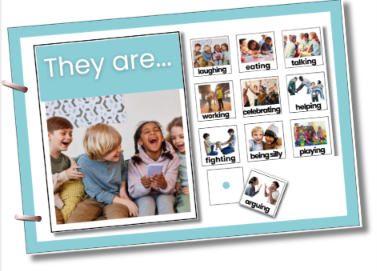
Some educators call predictable beginnings such as “I see…,” “I can…,” or “I want…” carrier phrases. They can create a familiar structure, but they should not turn into a drill in which the child must complete the adult’s sentence.
Model a variety of natural phrases so the child hears more than one way to communicate the same idea.
4. Build Language Into Play and Familiar Routines
Play provides repeated, meaningful opportunities to hear language. If a child enjoys cars, animals, bubbles, blocks, or pretend food, join the activity and describe what is genuinely happening.

Instead of testing the child with question after question, model comments and useful phrases:
“The car is stuck.”
“Help the puppy.”
“More bubbles!”
“The tower fell down.”
“My turn.”
“Your turn.”
Pause so the child has time to respond in their own way. Their response might be speech, a script, a gesture, a picture, an AAC selection, or an action.
5. Avoid Correcting or Stopping Harmless Scripts
Trying to eliminate echolalia simply because it sounds repetitive may remove language that serves a purpose. If a script is not understood, observe and stay curious.
If repetition is making it difficult for the child to participate, a speech-language pathologist can help determine what the child may be communicating and what additional supports are needed.
6. Honor More Than Spoken Language

Speech is only one form of communication. Continue responding to pointing, gestures, facial expressions, sign language, pictures, writing, and AAC.
This is especially important when a child can repeat long phrases but cannot yet reliably communicate basic needs. The apparent complexity of a script does not necessarily tell us what the child understands or can generate independently.
My post Why Doesn’t My Autistic Child Ask for Things? explains why having some spoken language and independently requesting what you need are not always the same skill.
Can AAC Support a Gestalt Language Learner?
Yes. A child does not have to choose between spoken scripts and augmentative and alternative communication, or AAC.
AAC includes many ways of communicating beyond speech, such as gestures, signs, picture boards, communication books, and speech-generating devices. Some people use AAC temporarily, while others use it throughout their lives. Many people combine AAC with speech.
A child who uses long spoken scripts may still have difficulty expressing a new thought, answering an unfamiliar question, or communicating a basic need. AAC gives the child another way to express wants, refusals, questions, thoughts, and feelings.
Do not remove or restrict AAC because a child begins speaking more. Also avoid limiting a robust communication system to a few requesting words if the child could use it to comment, protest, ask questions, joke, describe, or connect with people.
If you are new to visual communication, my post How to Use Picture Cards to Support Nonverbal and Minimally Verbal Children offers practical starting points.
You can also read What Is PECS? A Guide to the Picture Exchange Communication System to understand how PECS differs from simply showing a child picture cards. PECS is one specific, structured communication protocol; it is not a general name for every picture-based AAC system.
How Can Adapted Books Support Communication?

Adapted books are interactive books that invite a child to point, match, choose, move a piece, or complete another meaningful action while reading.
They can be helpful because they:
Provide a predictable structure.
Pair pictures with spoken or written language.
Create natural opportunities to point, choose, comment, and respond.
Make participation possible without requiring speech.
Repeat useful language within an understandable context.
Can be connected with a child’s interests and everyday experiences.
For example, a book may use a repeating pattern such as “I see a ___,” “The child is ___,” or “I can ___.” Familiar patterns can reduce the processing demands of the activity and help a child anticipate how to participate.
As the book becomes familiar, adults can model small variations, add comments, or connect the pictures with real experiences. The goal is not to make the child recite the carrier phrase perfectly. It is to create an enjoyable opportunity for shared attention, comprehension, choice-making, and communication.
There is research showing that physically performing actions can strengthen memory for words or phrases in some learning contexts—often called the enactment effect. Research on gesture and enactment is broader than autism and does not prove that moving Velcro pieces in an adapted book will produce flexible language. It does, however, offer one reason interactive participation may support attention and memory for some learners.
Adapted books should supplement, not replace, natural conversation, child-led play, AAC access, and individualized speech-language support.

If you would like ready-to-use interactive language materials, you can explore my adapted books in the Rainbow Autism Resources TPT store. They include books that practice labeling, carrier phrases, sentence building, early concepts, and social-emotional skills.
Frequently Asked Questions
What Is a Gestalt Language Processor in Simple Terms?
A gestalt language processor is a term used for someone who appears to learn or use language in larger chunks or memorized phrases.
For example, a child may repeat a complete phrase from a television program or familiar routine rather than building a new sentence one word at a time.
Is Echolalia Meaningless Repetition?
No. Echolalia can serve many functions, including requesting, answering, protesting, participating in an interaction, expressing emotion, rehearsing language, or self-regulating.
The meaning often becomes clearer when adults consider the situation in which the phrase occurs.
Is Every Autistic Child a Gestalt Language Processor?
No. Autistic children have varied language profiles. Some use frequent scripts or echolalia, some primarily generate original language, some communicate without speech, and many use a combination of communication forms.
How Can I Tell What a Script Means?
Look at the context, the child’s actions, their emotional state, and when the phrase usually occurs. Keep brief notes if that helps you notice patterns.
You do not need to interpret every script correctly before responding warmly and giving the child time.
Should I Correct Echolalia?
Avoid correcting or stopping harmless echolalia simply because it is repetitive. Respond to its likely meaning and model useful language naturally.
Seek individualized support if the child cannot reliably communicate their needs or is becoming frustrated.
Can a Child Use Both Echolalia and Original Language?
Yes. A child may use memorized scripts, individual words, original sentences, gestures, and AAC in different situations. Language development does not always fit neatly into one category.
Will AAC Stop a Child From Talking?
Research reviews have not found that AAC prevents speech development. AAC provides an additional way to communicate and should remain available based on the person’s needs and preferences.
Are Adapted Books Only for Children Who Speak?
No. A child can participate by looking, pointing, matching, choosing, moving pieces, signing, using AAC, or speaking. Adapted books should be designed so communication is possible in more than one way.
Final Thoughts on Gestalt Language Learning
My experience with that little boy in England stayed with me because his scripts were not random collections of words. They were part of how he connected with people, expressed himself, and participated in the world around him.
That remains the most valuable lesson.
When a child repeats a television line, echoes a question, or uses a phrase that does not immediately make sense to us, we can pause before correcting it. We can observe, listen, respond to the likely meaning, and make additional communication options available.
Over the years, research has increasingly supported something many parents, teachers, and therapists have observed in everyday interactions: echolalia can serve real communicative purposes. Recognizing that meaning allows us to respond to the child instead of focusing only on whether their language sounds conventional.
The goal is not to make every child’s language look the same. It is to help each child communicate more of what matters to them—with speech, scripts, AAC, gestures, pictures, or any combination that works.
If you are looking for more ideas, these related posts may help:
Do you work with a child who uses scripts or echolalia? What have their phrases helped you understand? Share your experiences in the comments.
Research and Further Reading
Macedonia, M., & Klimesch, W. (2014). Long-term effects of gestures on memory for foreign language words trained in the classroom. Mind, Brain, and Education, 8(2), 74–88.https://doi.org/10.1111/mbe.12047
Prizant, B. M., & Duchan, J. F. (1981). The functions of immediate echolalia in autistic children. Journal of Speech and Hearing Disorders, 46(3), 241–249.https://doi.org/10.1044/jshd.4603.241
Schlosser, R. W., & Wendt, O. (2008). Effects of augmentative and alternative communication intervention on speech production in children with autism: A systematic review. American Journal of Speech-Language Pathology, 17(3), 212–230.https://doi.org/10.1044/1058-0360(2008/021)


Comments