5 Simple Activities to Teach Basic Friendship Skills to Autistic Children (Ages 3–7)


Time to read: ~9 minutes
Many autistic children want to be around other children.
They may watch.

They may stand nearby.
They may follow what others are doing.
But when it comes time to actually join in…
that’s where things can feel hard.
That can look like:
wanting a toy but not knowing how to ask
grabbing instead of requesting
walking away instead of interacting
getting upset during sharing or turn-taking
playing alone, even when other children are close
From the outside, it can seem like a child “isn’t interested in friends.”
But most of the time, that’s not what’s happening.
For many autistic children, the challenge is not wanting friends.
It’s knowing how to take the small steps that lead to connection.
This is closely connected to flexible thinking—when things don’t go as expected, it can feel hard to join in. You can read more about that here.
TL;DR
Friendship skills are built through small, concrete actions
Many autistic children need explicit teaching and repeated practice
The most important beginning skills are:
taking turns
sharing
asking for something
giving something
The best way to teach these skills is through structured, hands-on activities
Practicing during calm, predictable moments helps children use these skills in real life
Table of Contents
What are early friendship skills in autism?
Why “being a friend” is hard to teach
5 activities that build early friendship skills
How to support minimally verbal children
Frequently asked questions
Final thoughts
What are early friendship skills in autism?
Friendship does not begin with conversation.
It begins much earlier than that.
It begins with simple actions like:
giving something to another child
taking turns
sitting near someone
responding when someone interacts
asking for something
If you look closely, friendship is not one big skill.

It is a series of small, connected actions.
Many autistic children need help learning these steps because they are not always intuitive.
They are not always picked up just by being around other children.
They often need to be:
shown
practiced
repeated
supported
Why “being a friend” is hard to teach
The phrase “he is a good friend” makes sense to adults.
But for a young child, especially a child who learns best through concrete experiences…
that phrase can be very unclear.
What does “be a friend” actually mean?
Without clear examples, children may not know what to do in the moment.
That’s why it helps to teach friendship skills in a way that children can:
see
feel
act out
repeat
Research supports this approach.
A meta-analysis by Bellini et al. (2007) found that social skills interventions are most effective when they include:
modeling
guided practice
real-life or naturalistic use
In other words:
👉 children learn social skills best when they are actively doing them
—not just being told about them.
5 Activities That Build Early Friendship Skills
1. Friendship Bracelet Activity
In this simple activity focused around creating a bracelet, children experience asking and giving in a very concrete way that they can see. Explain that they will each make a friendship bracelet by sharing their color of beads with their friends and asking different friends for new colors of beads for their own bracelet. As they receive a bead, they can string it on the pipe cleaner, and eventually an adult can help them turn it into a bracelet.
Each child is given:
one color of beads in a small container
a pipe cleaner
Right away, something important is happening.
Each child has something that other children need.
This creates a natural reason to interact.
Children are not being told to share.
They are placed in a situation where interaction is part of the activity.

Children practice:
asking for a bead
giving a bead
waiting while others take a turn
receiving something from a peer
At first, many children may not know what to say.
This is where modeling becomes important.
You can use simple, repeatable language:
“Can I have one?”
“Here you go”
“Your turn”
“Thank you”
You can also narrate what is happening or reference a visual support that shows options for requesting:
Keeping the structure consistent helps:
one bead at a time
everyone participates
clear beginning and end
2. Friendship Snack Mix Activity
In this activity, each child works together to share a scoop of a trail mix ingredient with a friend until everyone has the ingredients they would like in their mix and they can eat their snack together.
Each child:
has one ingredient (such as cereal, raisins, pretzels, etc)
a spoon or a scoop
a small bowl
a separate baggie or bowl to put their own trail mix in
Instead of losing something, children experience:

“I give something… and I get something back.”
You can support this with simple language:
“Give one scoop.” “Your turn.” “Now you get one.” “We are sharing with everyone.”
You can also narrate:
“You gave raisins to your friend.” “Your friend gave you popcorn.” “We are making something together.”
The structure matters:
one scoop at a time
clear turn-taking
everyone included
Over time, children begin to understand: sharing is part of being in a group
👉 The idea we are building is:“When I share, I am part of something with others.”
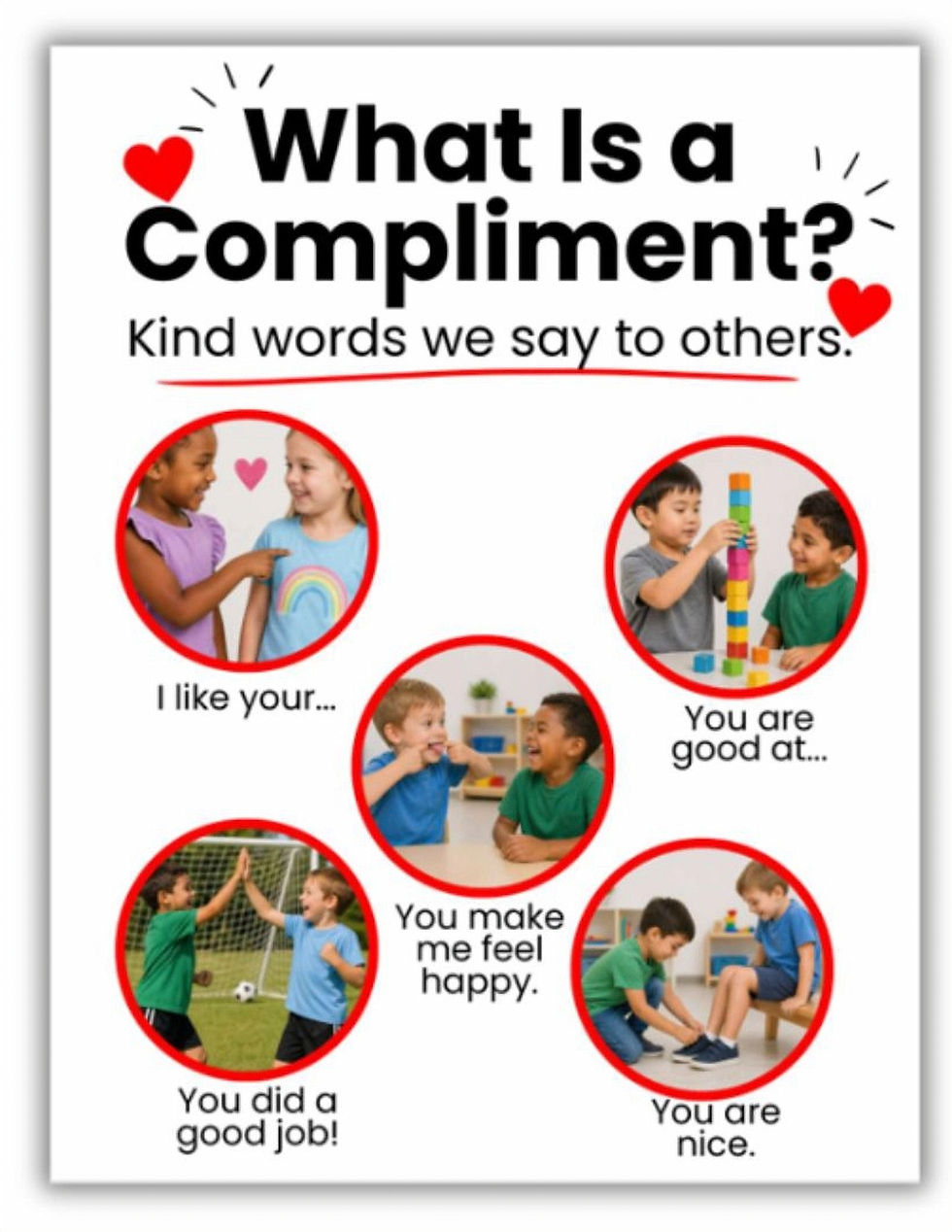
3. Compliment Toss Activity
Kind words are an important part of friendship, but many children do not automatically know what a compliment is or how to give one to peers.
In this activity, children sit in a circle with a soft ball. One child passes or tosses the ball to a friend, and when the friend catches the ball, the first child gives a compliment. They then throw or pass the ball to another friend and give a compliment. Game should continue until everyone has had a turn. It is helpful to discuss beforehand what a compliment is and have a visual nearby of reminders of things they could say to peers.

This turns something abstract into something children can practice.
They are not just told to “be nice.”
They experience what kind words sound like.
Over time, children begin to experience:
“I said something kind to someone and they responded positively"
4. Pretend Play Birthday Party
Some social situations are hard because they happen quickly and involve many steps. A birthday party is one of those situations. It includes:
greeting
giving
taking turns
asking questions
responding to others

In this activity, an adult sets up a pretend birthday party and offers visual supports to practice skills such as greeting, saying thank you, or asking a question.
Pretend play allows children to practice these steps slowly and with support.
You should make it clear that it is a birthday party using visual supports such as birthday candles placed into a playdough birthday cake, using an old gift bag with a toy in it, a sign that says "Birthday Party", etc.
Make the roles obvious and give children visuals so they understand and remember if they are the "birthday friend" or "party guest". You can also include visuals of things people might say or do at a birthday party.
5. Friend Skills Board Game

You can also use an old board game and pieces and make up cards with positive friend traits such as saying hello, sharing a toy, playing next to someone, etc. and a few non-positives such as taking a toy from a friend without asking.
Children select a card, and if they think it is a good friend skill, they move forward one space. If it is not, they stay in the same space. Make sure all students are allowed to get to the end of the game and "win".
This gives kids extra repetition and exposure to understanding what concrete things make a "good friend" and what things likely will not be appreciated. As well as giving kids the chance to work on turn taking and waiting-both critical basic friend skills. If children have difficulty begin this activity with one child and an adult only.
Supporting minimally verbal children
Some children are not ready for full sentences.
Start with:
giving
taking
pointing
handing items
Use:
visuals
gestures
AAC
modeling
Language can grow over time.
Frequently Asked Questions
Why doesn’t my autistic child play with others?
Often, it’s not lack of interest.
It’s:
not knowing what to do
not having the steps yet
feeling overwhelmed
What are the first social skills to teach?
Start with:
taking turns
sharing
asking
giving
How do these skills carry over to real life?
Through:
repetition
structure
practicing in real moments

Don’t have time to create your own visuals or activities? I’ve already put everything together in one place so you can print and use it right away— Friendship Skills games and activities with visuals included. Check it out HERE


Comments