Why Visual Supports Help with Emotional Regulation in Autism


Visual supports may seem simple, but for many autistic children, they offer structure when emotions feel overwhelming.
For many autistic children, visual supports help with emotional regulation in autism because they make emotions, body signals, and coping strategies more concrete, predictable, and easier to understand. When feelings are big, language often isn’t enough. Visuals give children something steady to return to.

In the last two posts, we talked about how to teach coping skills to autistic preschoolers and what to do when your autistic child gets mad. This post focuses on the why: why visual supports are such a powerful tool for teaching emotional regulation and helping coping skills actually stick.
TL;DR
Visual supports reduce language demands during emotional moments
They make abstract feelings and coping strategies concrete
Visuals allow coping skills to be practiced when children are calm
Research supports visual strategies for emotional regulation in autism
Table of Contents
What Are Visual Supports?
Visual supports are tools that help children understand information through pictures, symbols, and structured visuals rather than relying only on spoken language.
Visual supports can include:
Social skill stories
Adapted books
Posters and visual cards
Worksheets and structured activities
Portable visuals (such as cards on a lanyard)
All of these serve the same purpose: they make learning visible.
For autistic children, emotional regulation is often not intuitive. Visual supports help break emotions and coping strategies into smaller, understandable pieces that can be revisited again and again.
Why Do Visual Supports Help With Emotional Regulation in Autism?
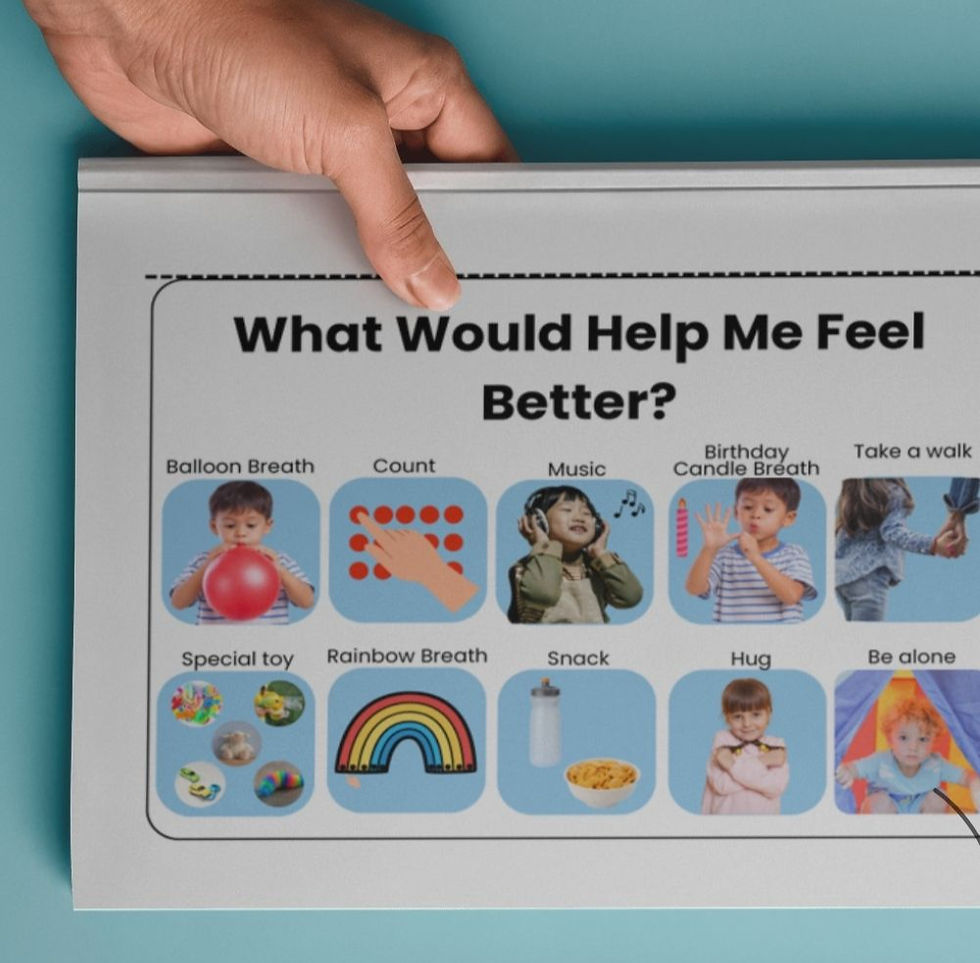
They Reduce Language Load
When a child is overwhelmed, processing spoken language can be extremely difficult. Visual supports for emotional regulation in autism provide information in a way that stays available even when words are hard to process.
Instead of trying to remember verbal instructions, children can see what to do.
They Increase Predictability
Uncertainty often intensifies emotional reactions. Visual supports show:
What is happening
What might happen next
What options are available
This predictability lowers anxiety and supports emotional regulation.
They Externalize Emotions
Visuals move emotions out of the child’s body and into the environment.
Instead of “something feels wrong,” visuals help children see:
What the feeling might be
What their body is telling them
What they can try to feel better
This reduces pressure and supports understanding.
They Allow for Practice During Calm Moments
Coping skills are far more effective when they are practiced before a child is overwhelmed.
Visual strategies for emotional regulation allow children to:
Learn coping skills when calm
Practice them repeatedly
Access them later when emotions rise
How Visual Supports Teach Coping Skills
Parents and professionals often ask: How do visual supports actually teach coping skills?
Building Body Awareness
Visuals help children notice early signs of overwhelm, such as tight muscles, fast breathing, or environments that feel “too loud.”

Making Coping Strategies Concrete
Instead of vague directions like “calm down,” visuals show:
How to breathe
How to ask for space
How to take a break
How to use movement or sensory input
This makes teaching coping skills with autism visuals far more effective.
Supporting Communication
Even children with limited verbal skills can:
Point to a feeling
Choose a coping strategy
Communicate what they need
Over time, this builds emotional awareness and independence.
Are Visual Strategies Evidence-Based?
Yes. Research consistently supports visual strategies as an effective way to teach emotional regulation in autism.
Mazefsky et al. (2013) emphasize that emotional regulation challenges are a core feature of autism and that teaching coping strategies—rather than focusing only on outward behavior—is essential.
Hodgdon (1995) documents how visual supports improve predictability, comprehension, and emotional organization, making abstract skills like calming more accessible.
When Should You Use Visual Supports?

Visual supports are most effective when used before emotions escalate.
They are especially helpful:
Before transitions
After emotional moments (to reflect calmly)
As part of daily routines
In therapy or classroom settings
Consistency matters more than perfection.
Types of Visual Tools That Support Emotional Regulation
Different children respond to different formats. Below are examples of visual supports that naturally support emotional regulation and coping skills.

Coping Skills Adapted Book
A structured, visual way to practice calming strategies step by step.👉 https://rainbowautism.etsy.com/listing/4346477472/coping-skills-adapted-book-for-autism
Calming Strategies Poster Cards
Visual reminders that can be displayed in calm-down spaces or used one-on-one.👉 https://rainbowautism.etsy.com/listing/1716693030/calming-strategies-poster-cards
Coping Skills Worksheets & SEL Activities
Hands-on activities that help children identify feelings, choose strategies, and reflect.👉 https://rainbowautism.etsy.com/listing/4354944259/coping-skills-worksheets-sel-activities

Coping Skills Cards for Lanyard
Portable visuals that give children quick access to coping strategies anywhere.👉 https://rainbowautism.etsy.com/listing/1766617202/coping-skills-cards-for-lanyard-autism

When I Feel Mad! – A Visual Social Skill Story
A visual story designed to help children recognize anger, notice body signals, and explore calming options in a concrete, supportive way.
If you prefer a physical, ready-to-use book, When I Feel Mad! is also available as a pre-printed paperback on Amazon (no downloading or printing required):👉 https://www.amazon.com/When-Feel-Mad-Introduce-Strategies/dp/B0GGZJMSF9
For families or educators who prefer digital resources, the printable version is available here:👉 https://rainbowautism.etsy.com/listing/1652708928/help-your-autistic-child-learn-coping
Final Thoughts
For autistic children, coping skills are not “nice extras.” They are foundational life skills.
Visual supports don’t remove challenges—but they make emotions feel safer, more predictable, and easier to understand. When children can see their options, they’re better able to use them.
Whether you’re supporting a child at home, in therapy, or in the classroom, visual tools help turn emotional regulation into something that can be learned, practiced, and strengthened over time.
FAQs
Why do visual supports help autistic children regulate emotions?
They reduce language demands, increase predictability, and make abstract feelings concrete.
How do visual supports teach coping skills?
They show children what emotions look like and what actions they can take, allowing practice before emotions escalate.
Are visual strategies effective for autism?
Yes. Visual supports are widely recommended in autism education and therapy.
Are visual supports evidence-based?
Research supports visual strategies as part of emotional regulation instruction, especially when paired with consistent practice.
Research & References
Kopp, C. B. (1989). Regulation of distress and negative emotions: A developmental view. Developmental Psychology, 25(3), 343–354.Mazefsky, C. A., et al. (2013). Emotion regulation in autism spectrum disorder. Journal of the American Academy of Child & Adolescent Psychiatry, 52(7), 679–688.Hodgdon, L. A. (1995). Visual Strategies for Improving Communication.


Comments